More time for your business!
Self-employed and always on? Not with us!
We take care of your taxes, you take care of your business.
Traditional methods and modern approaches
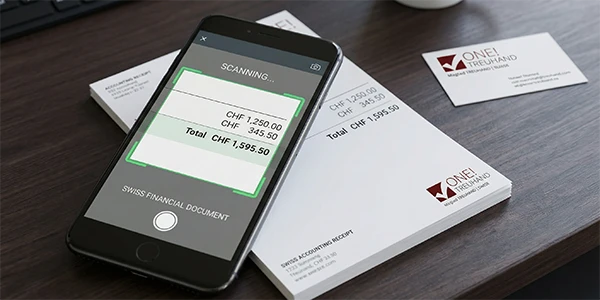
The so-called “Milchbüechli” accounting is not just a tradition: it is the simplified bookkeeping defined by law under Art. 957 para. 2 OR. It covers income, expenses and financial position and is open to sole proprietorships and partnerships with revenue of less than CHF 500,000. The principles of proper accounting apply to it accordingly. Many self-employed people are increasingly choosing modern, digital alternatives to optimize their processes.
Accounting for sole proprietorships and SMEs
Sole proprietorships have specific accounting requirements, while SMEs face additional challenges due to higher transaction volumes. In both cases, structured and careful bookkeeping is crucial.
VAT return and annual financial statements
Correct VAT accounting is a central part of bookkeeping. The annual financial statements serve to analyze financial performance and define goals for the future.
Since 1 January 2024, the VAT rates have been 8.1% (standard rate), 2.6% (reduced rate) and 3.8% (special rate for accommodation).
Frequently asked questions about accounting for the self-employed
Which accounting method is suitable for the self-employed?
Income and expense accounting is often used because it is simple and clear. Depending on the situation, however, other methods may make sense.
Is accounting software secure?
Modern accounting software generally works with encrypted data and offers protection against unauthorized access.
Do these accounting tips only apply to sole proprietorships?
No, many of the principles mentioned also apply to other legal forms such as GmbH or AG.
How often should the accounts be updated?
Regular updates, ideally monthly, help you keep track and respond to changes early.
Can you keep the accounts yourself?
Yes, this is possible with sufficient knowledge. Alternatively, you can bring in an accountant or fiduciary.