WhatsApp

+41445333425

Phone

+41 44 533 34 25

Email

welcome@onetreuhand.ch

+41 44 533 34 25

welcome@onetreuhand.ch

×

Accounting for the self-employed: keeping financial control and success in view

Well-kept accounts help self-employed people keep their finances under control, meet their legal obligations and make well-founded decisions.

12 January 2024 by Rodolfo Intaglietta
Last updated: 13 October 2026
Instructions
Advanced
15 min

Key facts about this article

Summary

For the self-employed, accounting is a central tool for managing the business financially. It creates transparency about income, expenses and the economic situation. Modern and automated solutions make bookkeeping easier and increase efficiency.

What you will learn:

  • Accounting basics for the self-employed
  • Accounting obligation and legal framework in Switzerland
  • Differences between manual and digital accounting
  • Income and expense accounting as an accounting method
  • Role of accountants and fiduciaries

Prerequisites

Some basic knowledge

Tools you need:

  • Accounting software or an online accounting solution
  • Digital filing for receipts and documents
  • Automated bookkeeping systems
  • Support from accountants or fiduciaries

Updated on 22 August 2026. We reviewed the accounting obligation, the retention periods and the statements on VAT. What has changed since first publication: the section on the accounting obligation was worded too broadly and has been corrected. The decisive factor is the revenue threshold of CHF 500,000 under Art. 957 OR; below it, simplified bookkeeping covering income, expenses and financial position is sufficient. For VAT, the rates of 8.1%, 2.6% and 3.8% have applied since 1 January 2024, instead of the previous 7.7%, 2.5% and 3.7%. Still valid without change: the ten-year retention period under Art. 958f OR, the principles of proper accounting, income and expense accounting as a permissible method, and the remarks on digital accounting and on working with a fiduciary.

Accounting for the self-employed in Switzerland

Accounting is the foundation of every business, including for the self-employed and sole proprietorships. It allows all financial transactions to be recorded and evaluated systematically and is directly linked to business success. Well-kept accounts create transparency about income, expenses and the financial situation.


Accounting obligation in Switzerland

Under Art. 957 para. 2 OR, sole proprietorships and partnerships with annual revenue below CHF 500,000 only keep simplified accounts of income, expenses and financial position. From CHF 500,000 in annual revenue, the full commercial accounting obligation with balance sheet and income statement applies. It is governed by the Code of Obligations and ensures that business transactions are correctly documented and archived. Legal entities such as GmbH and AG are fully subject to the accounting obligation regardless of revenue. Complying with these rules is a prerequisite for legal and tax compliance.


Manual accounting versus online accounting

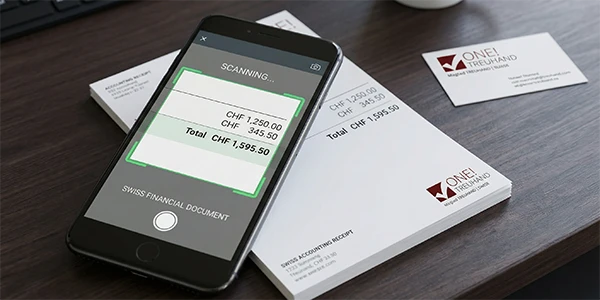
Traditionally, accounting was done manually. Today, however, digital and online solutions offer numerous advantages. They allow automation, access to data from anywhere and easier collaboration with fiduciaries or accountants. Receipts and documents are stored centrally, structured and easy to find.


Income and expense accounting

For many self-employed people, income and expense accounting is a suitable, simple accounting method. It records income and expenses at the time of the cash flow and gives a clear overview of the financial situation. Depending on the type and scope of the business, however, a different accounting method may be required.


Doing your own accounting or getting external support

Whether you keep the accounts yourself or outsource them to an accountant or fiduciary depends on individual factors. These include expertise, the complexity of the business and the time available. Professional support can help you avoid mistakes and make processes efficient.


Automated accounting systems

Modern accounting systems allow processes to be largely automated. They increase efficiency, minimize human error and provide an up-to-date overview of the company’s financial situation at any time.


Rules for the self-employed in Switzerland

Accounting records, accounting vouchers, the annual report and the audit report must be kept for ten years. The period begins at the end of the financial year. They may be kept on paper, electronically or in a comparable form, as long as the documents can be made readable again at any time (Art. 958f OR). In addition, there may be cantonal particularities that should be taken into account in accounting.

Role of the fiduciary

Fiduciaries support the self-employed with bookkeeping, accounting, and tax and personnel matters. They provide professional advice and ensure that legal requirements are met.


Accounting software and tools

A wide range of accounting software solutions is available to the self-employed. They range from simple templates to comprehensive programs that make bookkeeping efficient and convenient.

More time for your business!

Self-employed and always on? Not with us!

We take care of your taxes, you take care of your business.

Get to know our accounting

Traditional methods and modern approaches

The so-called “Milchbüechli” accounting is not just a tradition: it is the simplified bookkeeping defined by law under Art. 957 para. 2 OR. It covers income, expenses and financial position and is open to sole proprietorships and partnerships with revenue of less than CHF 500,000. The principles of proper accounting apply to it accordingly. Many self-employed people are increasingly choosing modern, digital alternatives to optimize their processes.


Accounting for sole proprietorships and SMEs

Sole proprietorships have specific accounting requirements, while SMEs face additional challenges due to higher transaction volumes. In both cases, structured and careful bookkeeping is crucial.


VAT return and annual financial statements

Correct VAT accounting is a central part of bookkeeping. The annual financial statements serve to analyze financial performance and define goals for the future.

Since 1 January 2024, the VAT rates have been 8.1% (standard rate), 2.6% (reduced rate) and 3.8% (special rate for accommodation).

Frequently asked questions about accounting for the self-employed

Which accounting method is suitable for the self-employed?

Income and expense accounting is often used because it is simple and clear. Depending on the situation, however, other methods may make sense.

Is accounting software secure?

Modern accounting software generally works with encrypted data and offers protection against unauthorized access.

Do these accounting tips only apply to sole proprietorships?

No, many of the principles mentioned also apply to other legal forms such as GmbH or AG.

How often should the accounts be updated?

Regular updates, ideally monthly, help you keep track and respond to changes early.

Can you keep the accounts yourself?

Yes, this is possible with sufficient knowledge. Alternatively, you can bring in an accountant or fiduciary.
Key takeaways

  • Accounting is essential for the success of the self-employed
  • Statutory accounting obligations must be met
  • Digital solutions simplify processes and save time
  • Automation reduces errors and improves the overview
  • Fiduciaries offer professional support and advice

For the self-employed, accounting is a central tool for financial management and for complying with legal requirements. With the right structure, suitable tools and, where appropriate, external support, bookkeeping can be efficient and reliable.

Professionally kept accounts create transparency, enable well-founded decisions and support long-term business success.

Sources

  1. Schweizerische Eidgenossenschaft. (1 January 2026). Obligationenrecht (OR, SR 220), Art. 957 and 958f. Retrieved 22 August 2026 from fedlex.admin.ch
  2. Eidgenössische Steuerverwaltung. (1 January 2024). Schweizer Mehrwertsteuersätze. Retrieved 22 August 2026 from estv.admin.ch
A competent tax advisor stands in a modern fiduciary office, ready to provide client-focused advice.

Author

Rodolfo Intaglietta

Rodolfo Intaglietta is the founder and managing director of ONE! Treuhand GmbH. As a Treuhänder mit eidg. Fachausweis (Swiss fiduciary with Federal Diploma of Higher Education) and Diplomierter Experte in Rechnungslegung und Controlling (Expert in Accounting and Controlling with Advanced Federal Diploma of Higher Education), he supports entrepreneurs throughout Switzerland with clear figures, digital processes and personal advice on an equal footing.

The qualification “eidg. diplomierter Experte in Rechnungslegung und Controlling” corresponds to qualification level NQF 8 and is therefore at the highest level of education, comparable to a doctorate in terms of professional depth and responsibility.