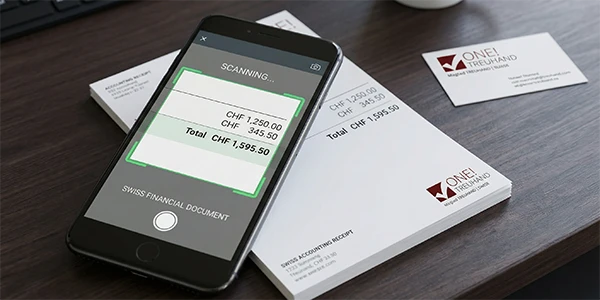
Have a professional handle your payroll accounting
Accounting and CFO services from a Swiss professional.
Typical year-end pitfalls for Swiss employers
In practice, these error patterns come up again and again:1,2,3,4,7
- Changes are left until December: Changes of residence, marriage, permit changes or adjustments to the employment level are not updated in the system promptly and have an incorrect effect on tax at source, allowances or salary reports.3,4
- Expenses and salary components are mixed up: Flat-rate allowances are posted without a sound tax logic and end up in the wrong place on the salary certificate at year-end.1
- Special cases are missing from the salary certificate: Longer interruptions in employment, home office or field work situations, or tax at source paid by the employer are not shown correctly.1,7
- Tax at source is only checked operationally, not over the whole year: The monthly deduction runs, but cross-border commuter or permit cases are set up with the wrong parameters.4
- One-off payments are underestimated: Bonuses, premiums, anniversary payments or salary components in foreign currency and cryptocurrency are checked too late and have to be converted or corrected afterwards.2
- Deadlines are misjudged: If you only prepare the salary certificate and the annual AHV report in January, you underestimate how compressed the year-end process is.3,5,6
Compact roadmap from Q4 to the end of January
October:
- Start with a check of master data and a review of all wage types.
- Identify special cases such as tax at source, company cars, flat-rate expense allowances, salaries in foreign currency, home office and longer absences.1,2,4,7
November:
- Clear up outstanding changes and test the salary certificate logic.
- In particular, check items that are more error-prone, such as benefits in kind, expenses, remarks and special declarations.
- Also reconcile vacation and absence balances.1,7,9
December:
- Finalize variable pay, check the last payroll run, document special cases properly and make sure that all facts relevant to the salary certificate are fully recorded by year-end.
- Improvising retroactively after the closing particularly often causes follow-up errors.1,2,3
January:
- Prepare salary certificates, transmit them on time and submit the annual AHV salary declaration by 30 January at the latest.
- Use electronic transmission channels if your payroll software supports them, and plan time for final plausibility checks.3,5,6,8
The decisive point is therefore less whether your January is well organized. What matters is whether your Q4 is properly prepared.
If you only clean up payroll accounting at year-end, you are not working more efficiently, just later and at higher risk.1,3,8
Frequently asked questions about preparing payroll accounting for year-end
Why should payroll accounting be prepared from Q4 onward?
Because typical year-end mistakes can rarely be resolved in January. From Q4 onward, you should clean up master data, wage types, tax at source cases, benefits in kind, expenses, absences and variable pay in particular, so that salary certificates and annual reports can be prepared on time and without rounds of corrections.1,2,3,4
By when do Swiss employers have to submit the annual salary declaration?
The salary declaration for AHV, IV and EO must be submitted to the compensation fund by 30 January following the end of the contribution year at the latest. If you settle or pay late, default interest may be charged.3
By when should salary certificates be available?
Employees usually receive their salary certificate by the end of January. Many cantonal tax administrations likewise require salary certificates to be submitted by the end of January of the following year.5,6
Which cases most often lead to incorrect salary certificates?
Common problem areas are company vehicles, tax at source cases, expenses without a clear distinction, longer interruptions in employment, home office or field work situations, employee participation plans, and salary components in foreign currency or cryptocurrency.1,2,4,7
Is Swissdec-certified payroll software worthwhile for the year-end process?
For many employers, yes. Swissdec-certified systems make it easier to transmit payroll and benefits data directly and in encrypted form to authorities and insurers, and they significantly reduce the manual effort for annual reports and salary certificates.8